Perform With Rick LIVE
Rick performs a few Symphonic Journey concerts in person every year. For more information or to book a live performance with Rick, please contact Ben Green.
Bring Rick Steves, America's leading authority on European travel, to the big screen for a dramatic musical journey…a journey that begins in the United States and touches down in eight European countries.
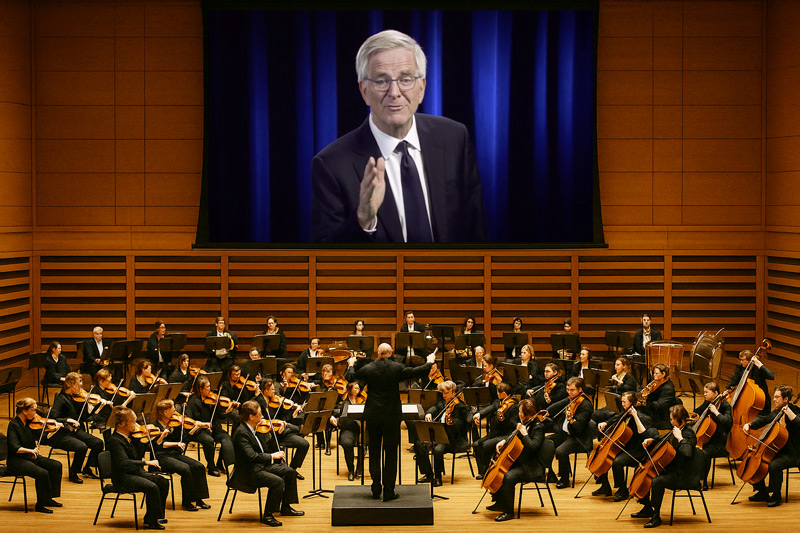
This collection of resources equips orchestra professionals with everything they need to produce “Rick Steves’ Europe: A Symphonic Journey” — a unique (and free) concert that celebrates music's power to stir the patriotic soul. Blending powerful Romantic-era anthems with breathtaking visuals, the concert takes audiences on a spectacular journey through Europe — with Rick as musical tour guide, setting up each piece with historical context and cultural insights.
After performing “A Symphonic Journey” live with orchestras for more than 10 years and filling concert halls across the USA, Rick now makes every concert resource — including a virtual performance by him for the big screen — available to orchestras for free.
This program is a gift, joyfully given by Rick, to support those who bring live classical music to the American public. Absolutely every resource has been digitized and can be downloaded at no cost — or, for $300, you can opt for a “Symphony in a Suitcase” and have the printed scores & parts shipped to you…literally in a suitcase.
The orchestra performs a selection of stirring 19th-century anthems by Romantic-era composers. The first nine pieces each feature a different nationality, while the finale, Beethoven's “Ode to Joy” (Europe's official anthem), pays homage to the continent's motto of “United in Diversity.” A surprise encore then celebrates a happy cultural homecoming back in the USA. And to help make the concert an unforgettable journey, each piece is accompanied by beautiful and evocative video images from the public television series Rick Steves’ Europe.
A step-by-step plan to smartly promote, produce, and perform “Rick Steves’ Europe: A Symphonic Journey.”
read more...
While this is certainly optional, you can follow this step-by-step plan to smartly promote, produce, and perform “Rick Steves’ Europe: A Symphonic Journey”:
Note: Please be sure, when referring to this concert in public, to always use its correct, copywritten, and full name: “Rick Steves’ Europe: A Symphonic Journey.”
Frequently asked questions about the concert.
read more...
Rick is offering this concert to orchestras in memory of his father, a beloved band director in Seattle-area public schools for many years. This is Rick’s way to support live classical music, which he believes is a beautiful (and in our country, often under-appreciated) dimension of culture. He hopes this concert will attract travelers and younger people who may then become regulars. And, of course, it’s a fun way for music lovers to learn a bit about Rick’s work as a travel writer and European tour guide.
If you use the downloadable PDF score & parts there are absolutely no costs. The newsletters you’ll pass out and the optional videos Rick is willing to record “localized” with your name and city are free. The only possible costs for this program are renting the printed scores (that’s the “Symphony in a Suitcase” for $300) if you so choose and shipping them back when finished.
No. You are required to indicate your interest via our short sign-up form.
The “Symphony in a Suitcase” scores & parts are printed on top-quality paper, feature a larger and easier-to-read format, and are staple-bound into well-ordered booklets. They may include markings from other orchestra musicians. And they come in cool Rick Steves luggage, along with a selection of autographed Rick Steves guidebooks you can share with VIPs or donors, use in fundraising, or gift to musicians.
Since this program’s debut in December 2025, the scores & parts have been managed and continually cleaned up and tweaked by our Symphonic Journey librarian, Paul Beck (Principal Librarian at the Milwaukee Symphony Orchestra). Paul welcomes your post-concert score suggestions in the Symphonic Journey Forum or via email ([email protected]).
This is the only piece in the concert with good arrangements not in the public domain — and since many orchestras already have a favorite arrangement, we decided to let them choose and provide their own versions.
Generally, no. But if you must cut the concert’s length down, the Rimsky-Korsakov piece (which introduces the 19th-century concept of “Exoticism” and is not part of Rick’s Nationalism/Romanticism narrative) is the easiest piece to omit.
You are strongly encouraged to run the concert in the order we have proposed. If you must change the program, however, please be very careful that the visuals and Rick’s welcome and post-intermission messages still make sense.
Yes. You do not need to use the scores & parts we provide, and you’re welcome to use other versions or arrangements of the pieces. You can also change the treatment of repeats and the length of each piece to your liking, as long as you remember to truncate any video clips that run longer than the music.
Yes, musicians who are eager to start practicing can download the free PDF before the printed versions arrive.
Look for “Symphonic Journey” in the homepage footer, enter “symphony” into the search bar, or bookmark https://brightwellreport.pro/symphony%3C/a%3E.%3C/p%3E
You are welcome to contact Symphonic Journey Librarian Paul Beck ([email protected]) to discuss which instruments can be omitted and how to make the instrumentation work for your ensemble.
Each orchestra can decide how to design its video transitions. Most will assemble the clips into a PowerPoint and will play arrangements that are substantially longer than the clips. Once a scenic montage is finished, you either pause on the video’s end image, which features a map, the name of the piece, and the composer’s portrait (this is the recommended way to fill the time before the music finishes), or you can display the Symphonic Journey banner on the screen.
Rick addresses the audience twice from a casual setting in his home: in a “welcome” video at the start of the concert and in a “welcome back” video at the beginning of the second half. He does this to set a comfy tone for an event where he’s otherwise quite formal and scripted. (Also, the casual intro to the second half allows Rick to mention the promotional value of the newsletter that is passed out, which is the one obligation orchestras have to perform Rick’s concert.)
Email your orchestra’s name and location with your request to [email protected].
You are welcome to simply complete the short sign-up form, use the information and resources on this page, and report on your wonderful event in our Symphonic Journey Forum after it’s finished with no further contac with us. But, if you have questions about the scores & parts or encounter any issues related to the performance, you can contact Librarian Paul Beck ([email protected]) — and Rick’s assistant Ben Green ([email protected]) can advise you on any administrative issues related to producing or promoting the concert. This is a new and innovative adventure for us that we expect will evolve and become better organized over time, and we are happy help and advise as needed. The goal: A “ Symphonic Journey” in your community that is so hugely successful (and available to you at such a great price) that you’ll want to sing its praises to symphonies across the land.
All orchestras performing this free concert must distribute copies of Rick’s travel newsletter with the concert program as attendees enter the hall before the concert. (This is a free, single edition publication with no subscription option. It shares Rick’s favorite discoveries and experiences and serves also as a catalog explaining his business: leading tours and writing guidebooks.) Not everyone will want one, and about one for every three people you expect to attend should be enough. (Note that the 64-page newsletters are shipped in full boxes, and there are 160 in each box.) So, if you expect 1,200 attendees at each of two concerts, that’s 2,400 in total, and you should order 800 newsletters (one for every three attendees), which will be sent to you in five boxes. (The shipping process will be explained to you after you sign up for the concert.) If you run out, that’s fine. If you have leftovers, you can toss them, find another use for them, or mail them back to us. (Just be careful not to overlook a box after it arrives, causing you to run out prematurely.)
While some orchestras are adept at printing out PDF scores & parts (the free option for your Symphonic Journey concert), for the nominal cost of $300, we will send you a Rick Steves-designed Rolling Carry-On (which normally retails for $180) filled with a complete set of scores & parts and a selection of autographed Rick Steves books. We hope you can gift the suitcase and the books to your favorite donors, use them in a raffle or other fundraising effort, or gift them to your musicians. We only ask that you safely pack the scores & parts into a shipping box after the concert and return the complete set to us for another orchestra’s use.
Contact Ben Green ([email protected]) to inquire about Rick’s availability and fee.
Our Promotional Tool Kit includes videos, graphics, promotional text, and more. In addition, Rick is happy to record a localized promo clip you can post on social media, and he can post a geo-targeted promo post on his own page that will reach his followers in your city. (Note: It is very important that your promotions make it crystal clear (i.e., explicit) that Rick will only be appearing on the big screen, and not in person. We advise using language like “While Rick will not be appearing on stage in person, he’ll be with you in spirit and up on the big screen.”)
Rick enjoys giving the A-students attending the concert more context (both historical and personal) to the pieces with a 20-minute “pre-concert talk” featuring a PowerPoint of images. This is popular at his live performances and can easily be offered virtually via a video on the big screen before the concert and/or as an embedded video on the orchestra’s website. The pre-concert talk is warm, fun, and rich in content. It not only provides important context that helps attendees get the most out of the concert, but also helps the audience get to know Rick and feel like he really is with them in spirit during the concert. If offering Rick’s pre-concert talk, please promote it so all attending know it comes with their ticket. (For more details, see the step-by-step instructions on how to do the concert.)
An incomplete list of conductors and orchestras who have performed this concert with Rick live is available below.
Rick’s father (Dick Steves) was a band director and piano tuner who was beloved by music lovers in the Seattle area. Back in the 1970s and 1980s, he imported the world’s finest pianos from Germany and sold them out of his store, “Steves Sound of Music.” When Rick was 14 years old, he traveled to Europe for the first time with his father to visit piano factories, including Bösendorfer (Austria) and Grotrian-Steinway (Germany). As a student at the University of Washington, Rick played the sousaphone in the Husky marching band and taught piano lessons in a studio next to his dad’s piano store. Eventually, he gave away his 50 piano students and turned his small recital hall into a lecture hall and the headquarters of his growing travel business. Today, Rick employs 100 Rick Steves’ Europe colleagues on the same street, and — as he has for decades — he spends about three months a year in Europe, researching guidebooks, fine-tuning his bus tour program, filming his TV show, and making new discoveries for travelers. And when he’s home, he’s never far from his shiny German grand piano (which he’s owned since before he bought his first car).
closeVideos of Rick’s introductions and scenic visuals for each piece, plus the scores & parts.
For each piece, a single video clip provides a roughly two-minute intro by your concert's tour guide, Rick Steves, followed by roughly four minutes of visuals from the composer’s country to be played as the orchestra performs, then finishing with a still image of the composer’s portrait designed to pause on until the piece is finished. You can create your own PowerPoint playlist from these individual videos (not changing the selections or the order they’re in) or download the entire standard program as a single 63-minute video.
All the primary clips (#1 through #14) are available in a single, quick-access YouTube video. This is only to be used as a fast and easy way to review what will be projected. (And Rick wants to be sure the musicians have a chance to see and hear what will be enhancing their performance.)
Runtime format: (Rick's intro + performance visuals = total runtime).
For your possible convenience, this is the entire program in one video string-out. It includes Rick's full narration and scenic clips for each piece. Play and pause as needed during your concert.
A complete set of printable scores & parts for the entire program (except for America the Beautiful, which you can choose your own arrangement for) can be downloaded as a free collection of PDFs or printed and shipped to you in a suitcase for $300. (Keep the suitcase, but return the scores after your concert.) Each part is about 30-50 staple-bound pages and includes edits and bowing marks. Paul Beck, the Principal Librarian at the Milwaukee Symphony Orchestra and our “Rick Steves’ Europe: A Symphonic Journey” librarian, is at your service ([email protected]) and can address any concerns or difficulties you have with the program’s scores & parts.
read more...
Flute 1
Flute 2
Piccolo
Oboe 1
Oboe 2
Clarinet 1 (in B-Flat and A)
Clarinet 2 (in B-Flat and A)
Bassoon 1
Bassoon 2
Bassoon 3 doubling Contrabassoon (this could be eliminated if need be)
Horn 1
Horn 2
Horn 3
Horn 4
Trumpet 1
Trumpet 2
Trumpet 3
Trumpet 4 (could be eliminated)
Trombone 1
Trombone 2
Trombone 3 (Bass Trombone)
Tuba
Timpani
Percussion (3 players playing bass drum; castanets; cymbals a2; field drum; glockenspiel; jingles; side drum; 2-snare drum; 2-suspended cymbals; tambour de basque; tambourine; triangle)
Harp
Piano/Organ (could be eliminated)
Violin 1 (the number of the strings depends on the size of the orchestra. We recommend a minimum of 8 Violin 1 players, 7 Violin 2 players, 6 Viola players, 5 cellos, 4 basses)
Violin 2 (7 players minimum recommended)
Viola (6 players minimum recommended)
Cello (5 players minimum recommended)
Bass (4 players minimum recommended)
Bassoon 3/Contrabassoon, Trumpet 4, and Piano/Organ could be eliminated if you don’t have enough players for those instruments.
We would like to assist you in making this concert possible, so please contact librarian Paul Beck at ([email protected]) to discuss your situation. He can help you figure out how to best fill out the instrumentation with the players you have. That being said, these pieces will require a full symphonic orchestra, and the musical intentions of the composer will suffer without enough instruments. Paul can advise you further!
Great! You can either change the bowings in the parts after you print them, or you are welcome to use your own parts and mark the cuts yourself, whichever is easier!
Yes! Please contact librarian Paul Beck ([email protected]). He can assist you with these parts.
If someone has verified if the measure numbers, rehearsal figures, and cuts are the same, your conductor is welcome to use their own!
Please let librarian Paul Beck know ASAP so that he can update the parts for other orchestras. The parts have been used before, but pesky mistakes can sometimes lurk!
Watch this short video to learn how Paul carefully prepares the suitcase for delivery:

Rick performs a few Symphonic Journey concerts in person every year. For more information or to book a live performance with Rick, please contact Ben Green.
For your convenience, you can print just the essentials for your concert (Program, Step-by-step instructions, FAQs, contact info).
Please direct questions that aren’t addressed in the FAQ, requests for localized welcome and promo clips, shipping instructions for newsletters, and anything else you need to successfully perform this concert (or book Rick for an in-person concert) to Rick’s assistant, Ben Green ([email protected]).
For questions about the scores & parts, contact librarian Paul Beck ([email protected]).
To inquire about Rick’s media availability and coordinate on other publicity efforts, contact Rick’s Communication Director, Amy Duncan ([email protected]).
The orchestra performs a selection of stirring 19th-century anthems by Romantic-era composers. The first nine pieces each feature a different nationality, while the finale, Beethoven's “Ode to Joy” (Europe's official anthem), pays homage to the continent's motto of “United in Diversity.” A surprise encore then celebrates a happy cultural homecoming back in the USA. And to help make the concert an unforgettable journey, each piece is accompanied by beautiful and evocative video images from the public television series Rick Steves’ Europe.
Usually, you'll find Rick Steves touring the great destinations of Europe. Now you can join him on a different journey: a Symphonic Journey. In this unique concert, Rick Steves appears not in person but on the big screen as he teams up with the talented [Anytown Orchestra]. The result is a performance that combines Europe's most stirring Romantic-era anthems with beautiful high-definition cinematography and Rick's tour-guiding insights into European history.
Rick Steves, America's leading authority on European travel, teams up with [Anytown Orchestra] and Maestro [Name] for an inspirational musical journey. The tour begins in the United States and then touches down in eight different European countries. The concert celebrates music's power to stir the patriotic soul. Playing musical tour guide, Steves utilizes his extensive knowledge of European history and culture to set the context for each piece. Then, with the help of evocative video images from his public television series, the orchestra performs a selection of stirring 19th-century anthems by Romantic-era composers, including Grieg, Smetana, Strauss, Saint-Saëns, Elgar, Wagner, and Verdi. Each selection honors a particular nationality, while the finale, Beethoven's "Ode to Joy" (Europe's official anthem), pays homage to the continent's motto of "United in Diversity" and its passion for freedom.
While this is certainly optional, you can follow this step-by-step plan to smartly promote, produce, and perform “Rick Steves’ Europe: A Symphonic Journey”:
Note: Please be sure, when referring to this concert in public, to always use its correct, copywritten, and full name: “Rick Steves’ Europe: A Symphonic Journey.”
Rick is offering this concert to orchestras in memory of his father, a beloved band director in Seattle-area public schools for many years. This is Rick’s way to support live classical music, which he believes is a beautiful (and in our country, often under-appreciated) dimension of culture. He hopes this concert will attract travelers and younger people who may then become regulars. And, of course, it’s a fun way for music lovers to learn a bit about Rick’s work as a travel writer and European tour guide.
If you use the downloadable PDF score & parts there are absolutely no costs. The newsletters you’ll pass out and the optional videos Rick is willing to record “localized” with your name and city are free. The only possible costs for this program are renting the printed scores (that’s the “Symphony in a Suitcase” for $300) if you so choose and shipping them back when finished.
No. You are required to indicate your interest via our short sign-up form.
The “Symphony in a Suitcase” scores & parts are printed on top-quality paper, feature a larger and easier-to-read format, and are staple-bound into well-ordered booklets. They may include markings from other orchestra musicians. And they come in cool Rick Steves luggage, along with a selection of autographed Rick Steves guidebooks you can share with VIPs or donors, use in fundraising, or gift to musicians.
Since this program’s debut in December 2025, the scores & parts have been managed and continually cleaned up and tweaked by our Symphonic Journey librarian, Paul Beck (Principal Librarian at the Milwaukee Symphony Orchestra). Paul welcomes your post-concert score suggestions in the Symphonic Journey Forum or via email ([email protected]).
This is the only piece in the concert with good arrangements not in the public domain — and since many orchestras already have a favorite arrangement, we decided to let them choose and provide their own versions.
Generally, no. But if you must cut the concert’s length down, the Rimsky-Korsakov piece (which introduces the 19th-century concept of “Exoticism” and is not part of Rick’s Nationalism/Romanticism narrative) is the easiest piece to omit.
You are strongly encouraged to run the concert in the order we have proposed. If you must change the program, however, please be very careful that the visuals and Rick’s welcome and post-intermission messages still make sense.
Yes. You do not need to use the scores & parts we provide, and you’re welcome to use other versions or arrangements of the pieces. You can also change the treatment of repeats and the length of each piece to your liking, as long as you remember to truncate any video clips that run longer than the music.
Yes, musicians who are eager to start practicing can download the free PDF before the printed versions arrive.
Look for “Symphonic Journey” in the homepage footer, enter “symphony” into the search bar, or bookmark https://brightwellreport.pro/symphony%3C/a%3E.%3C/p%3E
You are welcome to contact Symphonic Journey Librarian Paul Beck ([email protected]) to discuss which instruments can be omitted and how to make the instrumentation work for your ensemble.
Each orchestra can decide how to design its video transitions. Most will assemble the clips into a PowerPoint and will play arrangements that are substantially longer than the clips. Once a scenic montage is finished, you either pause on the video’s end image, which features a map, the name of the piece, and the composer’s portrait (this is the recommended way to fill the time before the music finishes), or you can display the Symphonic Journey banner on the screen.
Rick addresses the audience twice from a casual setting in his home: in a “welcome” video at the start of the concert and in a “welcome back” video at the beginning of the second half. He does this to set a comfy tone for an event where he’s otherwise quite formal and scripted. (Also, the casual intro to the second half allows Rick to mention the promotional value of the newsletter that is passed out, which is the one obligation orchestras have to perform Rick’s concert.)
Email your orchestra’s name and location with your request to [email protected].
You are welcome to simply complete the short sign-up form, use the information and resources on this page, and report on your wonderful event in our Symphonic Journey Forum after it’s finished with no further contac with us. But, if you have questions about the scores & parts or encounter any issues related to the performance, you can contact Librarian Paul Beck ([email protected]) — and Rick’s assistant Ben Green ([email protected]) can advise you on any administrative issues related to producing or promoting the concert. This is a new and innovative adventure for us that we expect will evolve and become better organized over time, and we are happy help and advise as needed. The goal: A “ Symphonic Journey” in your community that is so hugely successful (and available to you at such a great price) that you’ll want to sing its praises to symphonies across the land.
All orchestras performing this free concert must distribute copies of Rick’s travel newsletter with the concert program as attendees enter the hall before the concert. (This is a free, single edition publication with no subscription option. It shares Rick’s favorite discoveries and experiences and serves also as a catalog explaining his business: leading tours and writing guidebooks.) Not everyone will want one, and about one for every three people you expect to attend should be enough. (Note that the 64-page newsletters are shipped in full boxes, and there are 160 in each box.) So, if you expect 1,200 attendees at each of two concerts, that’s 2,400 in total, and you should order 800 newsletters (one for every three attendees), which will be sent to you in five boxes. (The shipping process will be explained to you after you sign up for the concert.) If you run out, that’s fine. If you have leftovers, you can toss them, find another use for them, or mail them back to us. (Just be careful not to overlook a box after it arrives, causing you to run out prematurely.)
While some orchestras are adept at printing out PDF scores & parts (the free option for your Symphonic Journey concert), for the nominal cost of $300, we will send you a Rick Steves-designed Rolling Carry-On (which normally retails for $180) filled with a complete set of scores & parts and a selection of autographed Rick Steves books. We hope you can gift the suitcase and the books to your favorite donors, use them in a raffle or other fundraising effort, or gift them to your musicians. We only ask that you safely pack the scores & parts into a shipping box after the concert and return the complete set to us for another orchestra’s use.
Contact Ben Green ([email protected]) to inquire about Rick’s availability and fee.
Our Promotional Tool Kit includes videos, graphics, promotional text, and more. In addition, Rick is happy to record a localized promo clip you can post on social media, and he can post a geo-targeted promo post on his own page that will reach his followers in your city. (Note: It is very important that your promotions make it crystal clear (i.e., explicit) that Rick will only be appearing on the big screen, and not in person. We advise using language like “While Rick will not be appearing on stage in person, he’ll be with you in spirit and up on the big screen.”)
Rick enjoys giving the A-students attending the concert more context (both historical and personal) to the pieces with a 20-minute “pre-concert talk” featuring a PowerPoint of images. This is popular at his live performances and can easily be offered virtually via a video on the big screen before the concert and/or as an embedded video on the orchestra’s website. The pre-concert talk is warm, fun, and rich in content. It not only provides important context that helps attendees get the most out of the concert, but also helps the audience get to know Rick and feel like he really is with them in spirit during the concert. If offering Rick’s pre-concert talk, please promote it so all attending know it comes with their ticket. (For more details, see the step-by-step instructions on how to do the concert.)
An incomplete list of conductors and orchestras who have performed this concert with Rick live is available below.
Rick’s father (Dick Steves) was a band director and piano tuner who was beloved by music lovers in the Seattle area. Back in the 1970s and 1980s, he imported the world’s finest pianos from Germany and sold them out of his store, “Steves Sound of Music.” When Rick was 14 years old, he traveled to Europe for the first time with his father to visit piano factories, including Bösendorfer (Austria) and Grotrian-Steinway (Germany). As a student at the University of Washington, Rick played the sousaphone in the Husky marching band and taught piano lessons in a studio next to his dad’s piano store. Eventually, he gave away his 50 piano students and turned his small recital hall into a lecture hall and the headquarters of his growing travel business. Today, Rick employs 100 Rick Steves’ Europe colleagues on the same street, and — as he has for decades — he spends about three months a year in Europe, researching guidebooks, fine-tuning his bus tour program, filming his TV show, and making new discoveries for travelers. And when he’s home, he’s never far from his shiny German grand piano (which he’s owned since before he bought his first car).
Please direct questions that aren’t addressed in the FAQ, requests for localized welcome and promo clips, shipping instructions for newsletters, and anything else you need to successfully perform this concert (or book Rick for an in-person concert) to Rick’s assistant, Ben Green ([email protected]).
For questions about the scores & parts, contact librarian Paul Beck ([email protected]).
To inquire about Rick’s media availability and coordinate on other publicity efforts, contact Rick’s Communication Director, Amy Duncan ([email protected]).